
What Happens After a Longevity Workup? The Part Nobody Talks About
A longevity workup is a very deep check-up. It looks for health risks years before they turn into problems, so you can act early.
Most of the conversation is about the tests: which blood markers, which scans, which lab. Very little is about what happens after the results come back. That's where the value either shows up or doesn't.
What's usually in a longevity workup?
Programs vary, but most include some mix of:
Advanced blood work. Far more markers than a standard annual physical.
Heart and artery imaging. A look at how your cardiovascular system is aging.
A body composition scan. Muscle, fat and bone, not just weight.
A fitness test (VO2 max). How well your body uses oxygen, one of the strongest signals of long-term health.
Sometimes genetics or a full-body MRI.
You can often get all of it done in a morning. The testing is the easy part.
Why the results are the hard part
A full workup can produce dozens of numbers, a few of them flagged in red. On their own, those numbers aren't medicine. They're information.
What turns them into something useful is a qualified doctor who looks at all of it together, explains what it means for you, and builds a plan with a clear owner and a clear timeline.
That step is often missing. Many people leave with a long PDF and no one to explain it, and end up searching forums to make sense of results they paid good money for.
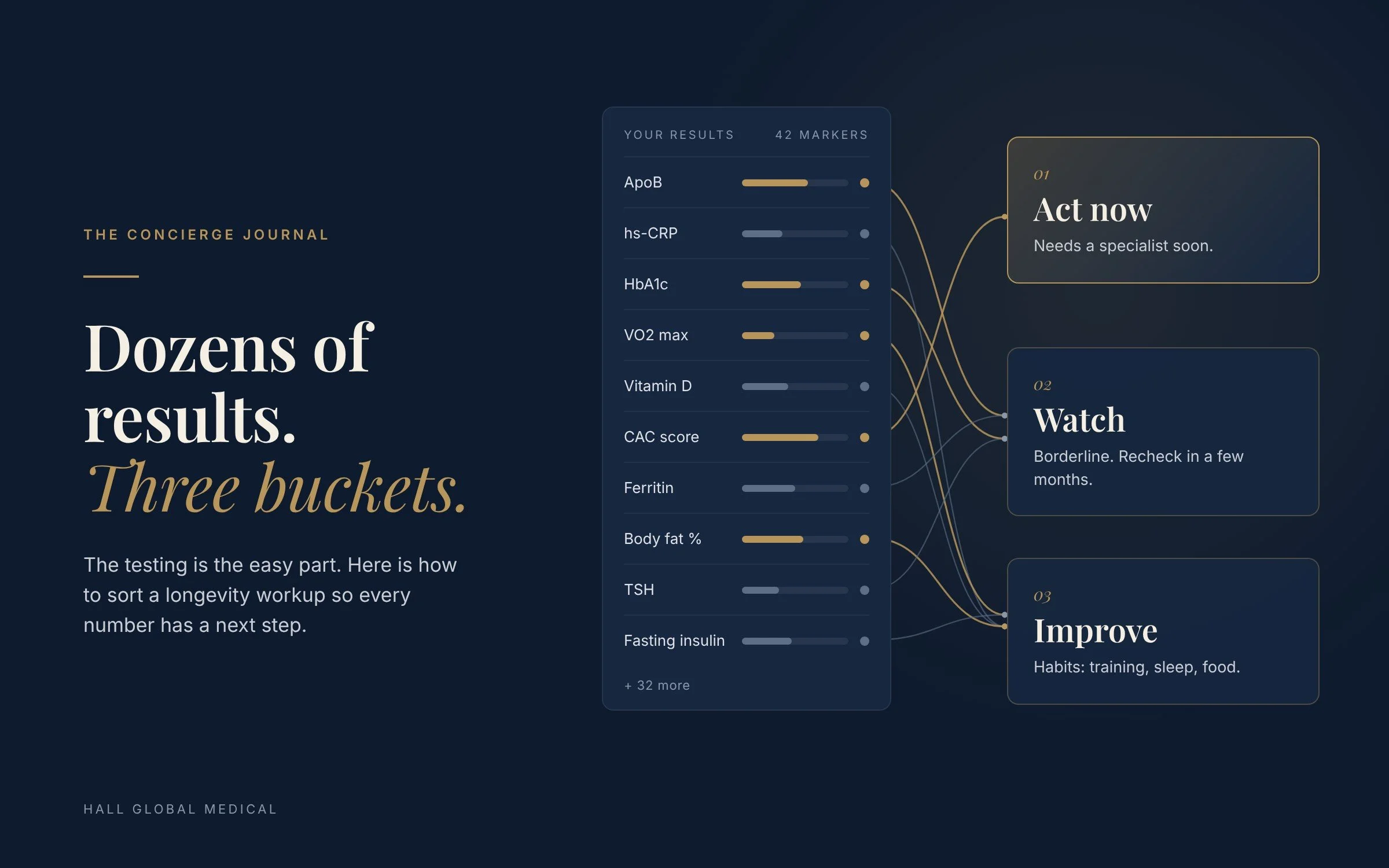
What to do with your results: three buckets
A simple way to think about any set of results is to sort each one into one of three buckets:
Act now. Anything that needs a specialist soon.
Watch. Borderline results to recheck in a few months.
Improve. Habits to work on, like training, sleep and food.
What sorting looks like in practice:
Act now: A heart scan shows plaque building up in an artery. That goes to a cardiologist within the next few weeks.
Watch: A blood sugar marker (HbA1c) comes back slightly above normal. Recheck it in a few months.
Improve: VO2 max is below average for your age. Build a training plan around it and retest in about six months.
Then share everything with your doctor at home, so the results become part of your ongoing care instead of a file in your inbox.
What a good follow-up should include
Before you book any workup, ask whether it includes:
A scheduled review of your results with a physician, not just an automated report
A plain-English summary of what's actionable and what isn't
A clear path for anything urgent
A plan for retesting or monitoring, so the workup is the start of something, not a one-time event
How HGM looks at this
When I look at a longevity or diagnostics clinic for a client, the list of tests is rarely what sets the best apart. Most top clinics run excellent tests. What I want to know is what happens once you're home with your results: who explains them, who you call with a question, and when you test again. The clinics with a clear answer are the ones I feel confident recommending.
Get The Diligence Gap first. On October 20 we're releasing our first HGM Report on what top clinics do (and don't) tell you before you book. Join the HGM Insider to get it first.
Comparing programs right now? A Preliminary Case Review is built to catch exactly this kind of gap before you commit.
This article is for general education and isn't medical advice. Talk with your doctor about your own results.